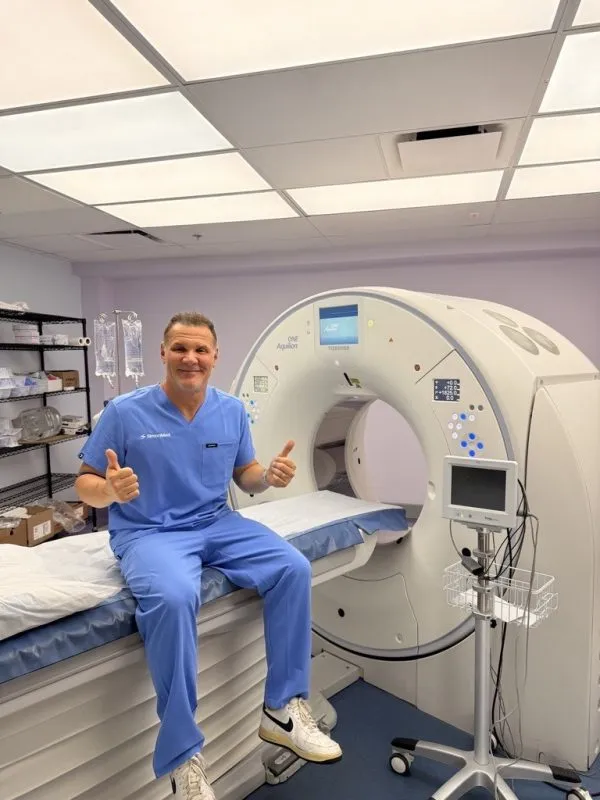
When radio personality Johnjay Van Es lost his father unexpectedly to a heart attack at age 66, it changed the way he thought about his own health.
His father had been an athlete his entire life. He was physically active, appeared healthy, and showed no obvious signs that something was wrong.
The loss was a wake-up call for Johnjay, who was raising three young sons and struggling with his own health at the time.
He was approximately 150 pounds heavier than he is today, and everyday activities like playing with his children had become difficult.
Losing his father made Johnjay realize something important: he wanted to be there for his family, not just today, but for as many healthy years as possible.
That realization became the beginning of a lasting transformation.
A lifestyle change that shaped his family’s future
After his father’s passing, Johnjay committed to making his health a priority. He changed his eating habits, began exercising regularly, and gradually lost approximately 150 pounds. But for Johnjay, the biggest transformation wasn’t necessarily what he saw on the scale.
It was how his new lifestyle changed the way his children saw him.
“My kids remember dad on the treadmill, dad lifting weights, dad going on a hike, me taking them with me.”
Today, running, hiking, and staying active are part of his everyday life. More importantly, they’re activities he can share with his family.
By making healthier choices, Johnjay didn’t just change his own routine. He helped create a different example of what healthy living looks like for his children.
And as he gets older, he’s thinking more about how to maintain those habits for years to come.
Why understanding his health matters more than ever
Johnjay’s father wasn’t the only parent he lost at age 66. His mother also passed away at 66 after developing glioblastoma, an aggressive form of brain cancer.
Those losses gave Johnjay a deeply personal reason to better understand his own health. He had changed his eating habits and made exercise part of his everyday life, but he knew those habits couldn’t tell him everything about what was happening inside his body.
That desire for more information brought him back to SimonMed for a whole-body MRI and a closer look at his heart health.
“Going into this, I’m hoping for answers and peace of mind. both.”
Whole-body MRI uses magnetic fields and radio waves to create detailed images without radiation. SimonMed’s core exam evaluates the chest, abdomen, and pelvis, including organs such as the liver, kidneys, and prostate. Depending on the package, imaging can also include the brain, neck, and spine. The images help radiologists look for potential concerns, including suspicious masses and other structural changes that may need further evaluation.
Johnjay’s visit also included a coronary CT angiogram (CCTA) with AI Plaque Analysis. This exam uses CT imaging and an IV contrast dye to examine the coronary arteries—the blood vessels that supply the heart—and look for plaque buildup and narrowing. AI analysis helps measure how much plaque is present and characterize its type, including both calcified plaque and noncalcified, or “soft,” plaque. That information helps clinicians better understand coronary artery disease and guide decisions about prevention or treatment.
For Johnjay, whose father had appeared healthy before his heart attack, understanding his heart health was especially meaningful. He wanted more information while he was feeling well, with medical professionals to help him understand the findings.
Seeing what had changed—and what hadn’t
This wasn’t Johnjay’s first whole-body MRI. He had completed one at SimonMed approximately three years earlier, giving his medical team a baseline to compare with his new images.
That comparison was an important part of his return visit: an opportunity to see what had changed and what remained stable.
During his results review, the team explained that his neurovascular imaging showed no concerning findings in the areas reviewed. Degenerative changes in his spine also appeared stable compared with his earlier imaging.
Reviewing the images with the team gave Johnjay a chance to ask questions and understand what the findings meant in the context of his health over time.
Imaging can’t predict every health issue or replace regular medical care. For Johnjay, it was one part of an ongoing commitment to his health—and to being there for his family in the years ahead.
More life for the moments that matter
After losing both parents at 66, Johnjay understands how precious time with family can be. His motivation to stay healthy has evolved over the years; what started as a desire to keep up with his three young sons has grown into something much bigger.
He wants to keep running, hiking, and exploring new places. He wants more adventures with his wife and more memories with his children. And one day, he hopes to experience another important chapter of family life.
“Grandkids. When they do come, I want to be able to be an active grandfather.”
For Johnjay, longevity isn’t simply about reaching a certain age. It’s about having the health and energy to enjoy the years ahead—with his wife, his children, and the grandchildren he hopes to have one day.
That’s what motivates him to keep making his health a priority: more adventures, more memories, and more time together.
What does more life mean to you? Explore SimonMed’s Whole-Body MRI and Longevity services to learn more about taking a proactive approach to your health.