You know your body better than anyone.
You know what looks normal and what changes throughout the month. Your breasts are no different.
Getting familiar with how your breasts normally look and feel can make it easier to recognize when something changes; that’s the idea behind knowing your normal.
A regular breast self-check isn’t about searching for something wrong, and it doesn’t have to be complicated or performed perfectly. It’s merely a way to become more familiar with your body so you’re more likely to notice something new or different.
Because when you know what’s normal for you, you’re better equipped to recognize what isn’t.
What does it mean to “know your normal”?
No two people’s breasts are exactly alike. Breasts can naturally differ in size, shape and texture. They can also change over time and throughout your menstrual cycle.
There isn’t one universal definition of what breasts are “supposed” to feel like.
During a recent episode of SimonMed’s More Life for Living podcast, Ultrasound Director Lexy Alvarez and Mammography Director Christie Castro emphasized the importance of becoming familiar with your own breast tissue. Checking yourself regularly helps you understand what typically feels normal for your body.
The goal isn’t to diagnose yourself. It’s to be able to say, “I know what this usually feels like. And this feels different.”
How often should you check your breasts?
You don’t need to check every day. In fact, checking too frequently may make it harder to recognize meaningful changes.
Instead, consider making breast awareness part of your regular routine.
A monthly check-in can be a helpful way to become familiar with how your breasts normally look and feel. Breast tissue can change throughout the menstrual cycle, so keeping your timing consistent can make it easier to compare what you’re feeling from one month to the next.
The shower can be a convenient place to start. As explained in the podcast, soapy, slippery skin can make it easier to move your fingertips smoothly across the breast, rather than pinching or grabbing the tissue.
Consistency matters more than perfection. Try checking around the same time each month.
How to perform a breast self-check
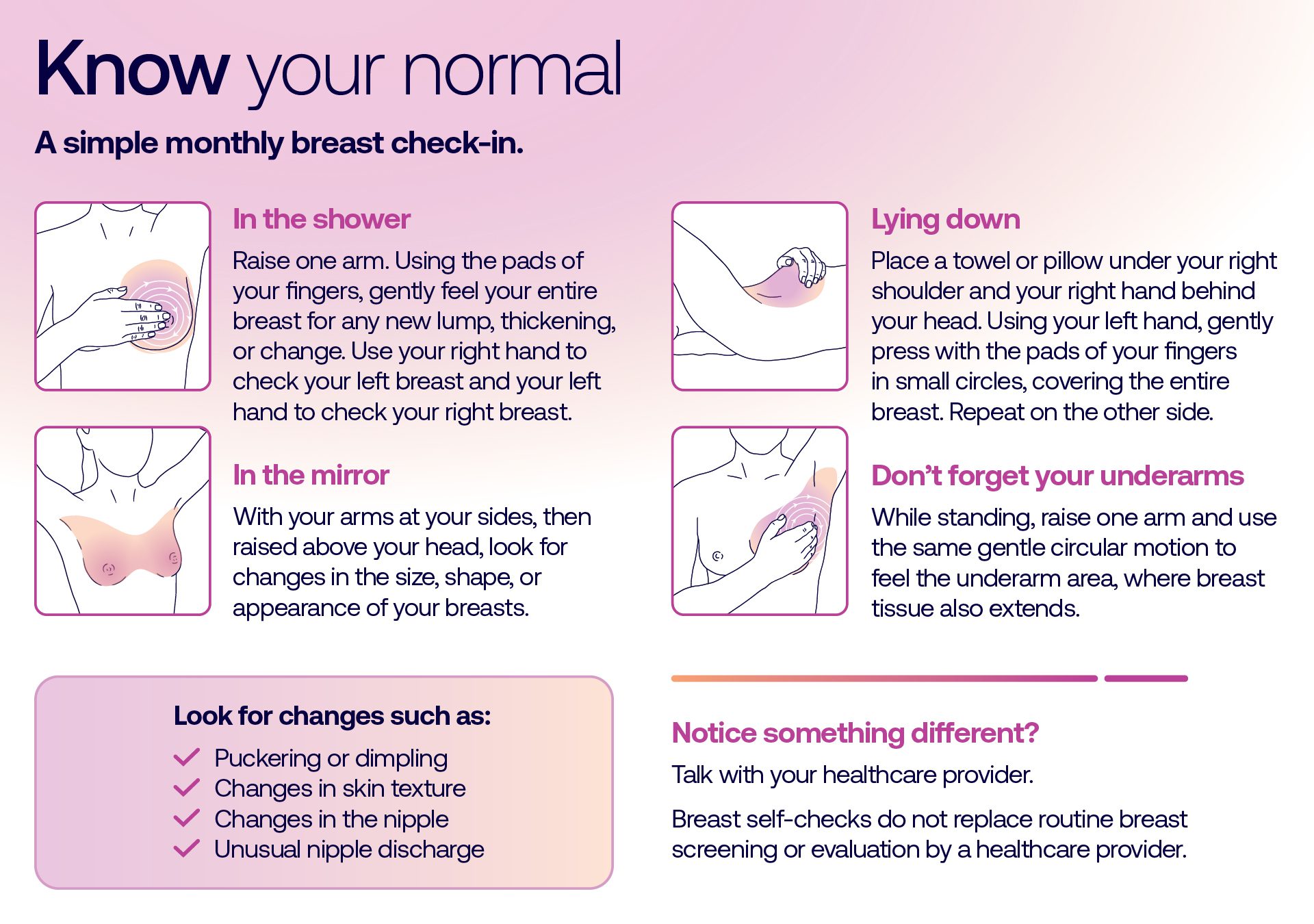
There are a few simple ways to check in with your breasts. SimonMed’s Know Your Normal guide breaks the process down into four steps: in the shower, in the mirror, lying down and under your arms.
In the shower
Raise one arm. Using the pads of your fingers, gently feel the entire breast for anything new or different, including a new lump or area of thickening.
Use your right hand to check your left breast and your left hand to check your right breast.
Rather than pinching the tissue, let the pads of your fingers move across the breast so you can become familiar with how the area normally feels.
In the mirror
Looking is part of knowing your normal, too.
Stand in front of a mirror with your arms at your sides. Then raise your arms above your head.
Look at your breasts and pay attention to their usual size, shape and appearance. Over time, that familiarity can make a new visual change easier to recognize.
Lying down
Place a towel or pillow under your right shoulder and put your right hand behind your head.
Using your left hand, gently press with the pads of your fingers in small circles, covering the entire breast. Then repeat on the other side.
The goal is simply to become familiar with how your breast tissue normally feels.
Don’t forget your underarms
Your breasts aren’t the only area to get to know.
Breast tissue extends toward the underarm, so include this area in your monthly check-in. While standing, raise one arm and use the same gentle circular motion to feel your underarm.
What changes should you look for?
Here’s the important part: you’re looking for what’s new or different for you.
Breasts naturally have texture. They aren’t necessarily perfectly symmetrical, and how they feel can change throughout your menstrual cycle.
A difference doesn’t automatically mean something is wrong. Instead, knowing your normal gives you a baseline. Changes worth bringing to your healthcare provider’s attention can include:
- A new lump or thickening
- Puckering or dimpling
- Changes in skin texture
- Changes in the nipple
- Unusual nipple discharge
- A new change in the size, shape or appearance of a breast
Something feels different. Now what?
Start with your healthcare provider. A breast self-check can help you notice a change, but it can’t tell you what that change means.
Not every breast change is cancer, and the goal isn’t to figure that out on your own. If something looks or feels different from what’s normal for you, bring it to the attention of a healthcare professional.
That’s why getting familiar with your breasts matters: you’ll have a better sense of when it’s time to ask questions.
If you notice a new or unusual change, don’t wait until your next routine mammogram to bring it to your healthcare provider’s attention.
Breast self-checks don’t replace screening
Knowing your normal is just one part of being proactive about your breast health.
Routine breast screening is another. Breast self-checks do not replace routine breast screening or evaluation by a healthcare provider. SimonMed’s Know Your Normal guide pairs its monthly self-check instructions with a reminder to stay current with mammography.
Your recommended screening schedule may depend on factors including your age, personal health history and individual risk. Talk with your healthcare provider about the screening schedule that’s appropriate for you.
Mammography can detect breast changes that you may not be able to see or feel yourself. That’s why breast awareness and routine screening work toward the same goal in different ways: helping you stay informed about your breast health.
Know your normal—and know when you’re due
Being proactive about breast health doesn’t have to mean worrying that something is wrong. It can mean paying attention, so know how your breasts normally look and feel. Check in regularly so you’re more likely to recognize when something changes.
Then make routine breast screening part of the picture, too.
Knowing your normal is one simple way to take an active role in your breast health. Pair that awareness with regular screening and conversations with your healthcare provider.
Notice something different? Talk with your healthcare provider.
Due for your routine screening?
Frequently
Asked
Questions
A monthly check-in can help you become familiar with how your breasts normally look and feel. Try to check around the same time each month, since breast tissue can change throughout the menstrual cycle.
Look and feel for something new or different from what is normal for you. That may include a new lump or thickening, puckering or dimpling, skin-texture changes, nipple changes, unusual nipple discharge, or a new change in the size, shape or appearance of a breast.
Yes. Breast tissue extends toward the underarm, so SimonMed’s Know Your Normal guide recommends including the underarm area in your regular check.
Talk with your healthcare provider. A self-check can help you recognize a change, but it cannot determine what that change means.
No. Breast self-checks can help you become more familiar with your body, but they do not replace routine breast screening or evaluation by a healthcare provider.