A coronary artery calcium score of zero can be reassuring. But there’s an important limitation many people don’t realize:
A calcium score measures calcified plaque. It does not measure every type of plaque in your coronary arteries.
That distinction matters because coronary artery disease can begin long before plaque becomes calcified. Earlier-stage, noncalcified plaque—often called “soft plaque”—may be present even when your calcium score is zero. Some forms of noncalcified plaque can also have characteristics associated with greater vulnerability to erosion or rupture, which can contribute to a heart attack.
So while a calcium score can provide valuable information about cardiovascular risk, it answers one specific question. It does not provide a complete picture of the plaque inside your coronary arteries.
What does a calcium score actually measure?
A coronary artery calcium, or CAC, scan is a noncontrast CT exam that detects calcium within plaque in the coronary arteries.
The scoring method most commonly used today—the Agatston score—was introduced in 1990. CT technology has advanced significantly since then, but the fundamental purpose of CAC remains the same: detecting and quantifying calcified plaque.
When your calcium score is zero, it means:
- No measurable calcified coronary plaque was detected.
- Your near-term cardiovascular risk is generally lower than someone with detectable coronary calcium.
- It does not necessarily mean your coronary arteries are completely free of plaque.
That last point is especially important.
The plaque a calcium score can miss
Coronary artery disease develops over time, and plaque does not necessarily begin as calcium.
Noncalcified plaque may accumulate within an artery before enough calcium develops for it to register on a CAC scan. That means someone can have:
- A calcium score of zero
- No detectable calcified plaque
- Noncalcified coronary plaque that the calcium scan cannot measure
The calcium score isn’t “wrong.” It is simply answering the question it was designed to answer.
More advanced coronary imaging can answer a different—and broader—question: What plaque is actually present inside my coronary arteries?
Why age matters
Age can make the limitations of calcium scoring particularly important.
In younger adults
Younger adults have had less time for coronary plaque to become calcified. As a result, a calcium score of zero can be less definitive in a younger person, particularly when significant risk factors are present.
Research has shown that younger people can have noncalcified coronary disease despite having no detectable coronary calcium, and CAC zero becomes less reliable for excluding obstructive disease in very young patients.
That may be especially relevant for someone with factors such as a strong family history of premature heart disease, inherited lipid abnormalities, diabetes or other significant cardiovascular risk factors.
In older adults
At older ages, coronary calcium becomes increasingly common. CAC can still provide meaningful risk information—it should not be considered a “false positive”—but calcium alone cannot tell you the complete composition of a person’s plaque or identify whether noncalcified, potentially higher-risk plaque features are present. CAC remains predictive of cardiovascular risk even in older populations.
The goal is not simply to find more disease. It is to better understand what kind of disease is present and what that means for an individual patient, helping physicians make more informed prevention and treatment decisions.
Why repeating a calcium score may be misleading after treatment
There is another limitation of calcium scoring that many people don’t know about: it is not necessarily an ideal way to measure whether coronary plaque is improving after treatment has begun.
For example, statin therapy can change plaque composition. Research using coronary CT angiography has shown that statins may slow overall plaque progression, reduce high-risk plaque characteristics and at the same time increase plaque calcification.
That means someone taking appropriate preventive therapy could have more calcium on a later CAC scan while simultaneously developing a more stable plaque profile.
For that reason, simply comparing one calcium score with another may create a misleading picture of treatment response, particularly in people taking statins.
Seeing beyond calcium with CCTA
Coronary CT angiography, or CCTA, allows physicians to look directly at the coronary arteries using contrast-enhanced CT imaging.
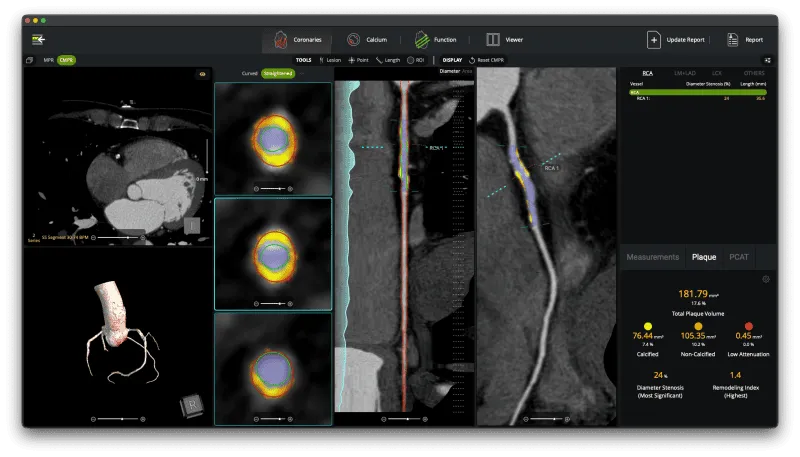
Unlike a calcium score, CCTA can identify both calcified and noncalcified plaque. When combined with advanced AI plaque analysis, it can also quantify plaque burden and characterize plaque composition—providing information that a calcium score alone cannot.
And the technology has changed substantially. Modern CT scanners, acquisition techniques and image-reconstruction technologies have dramatically reduced radiation exposure from CCTA compared with earlier generations of cardiac CT. Large international research has documented major declines in CCTA radiation dose over time.
CAC remains a low-dose, accessible and useful tool when the clinical question is whether coronary calcium is present. Current cardiovascular guidelines continue to recommend its selective use for certain patients whose cardiovascular risk or treatment decisions are uncertain.
But when the question is “What plaque is actually in my arteries?”, CCTA can provide a much more detailed view.
Looking at the whole cardiovascular picture
Imaging is only one component of understanding cardiovascular risk.
Blood pressure, cholesterol, ApoB, lipoprotein(a), glucose and metabolic health, family history and lifestyle all help determine an individual’s risk.
That broader approach is the philosophy behind SimonMed’s Cardiovascular Longevity program.
The program combines:
- Advanced coronary CT angiography
- AI-powered plaque analysis that assesses calcified and noncalcified plaque
- More than 25 cardiovascular and metabolic biomarkers
- A one-on-one consultation with a preventive cardiologist
Together, these tools are designed to look beyond a single calcium score and provide a more complete picture of cardiovascular health.
A zero is good news. It isn’t the whole story.
A calcium score of zero is reassuring—but it doesn’t mean “zero plaque,” and it doesn’t mean “zero risk.”
It means zero measurable calcified plaque.
Understanding that distinction can be important, particularly for younger adults, people with significant cardiovascular risk factors, and anyone trying to understand their coronary health beyond a single number.
Today’s technology gives physicians the ability to see more than calcium alone. The goal isn’t simply more testing. It’s better information—so preventive decisions can be more personalized and patients are less likely to be either undertreated or treated based on an incomplete picture of their cardiovascular health.
Discover how SimonMed’s Cardiovascular Longevity program combines advanced coronary imaging, AI-powered plaque analysis and comprehensive biomarker testing to provide a more complete picture of your cardiovascular health.
Frequently
Asked
Questions
A calcium score measures the amount of calcified plaque detected in the coronary arteries. It can provide useful information about cardiovascular risk, but it does not measure noncalcified or “soft” plaque.
Yes. A calcium score of zero means no measurable calcified plaque was detected. Noncalcified plaque, sometimes called soft plaque, may still be present because a calcium score is designed to detect calcium rather than every type of coronary plaque.
No. A zero calcium score is generally reassuring and is associated with lower cardiovascular risk, but it does not mean zero risk. Your overall risk also depends on factors such as age, family history, cholesterol and other biomarkers, blood pressure and metabolic health.
No. A calcium score measures calcified plaque. Noncalcified or “soft” plaque may not appear on a standard calcium scan, which is one reason a calcium score does not provide a complete picture of coronary plaque.
It can be. Younger adults have had less time for coronary plaque to become calcified, so a calcium score of zero may not exclude noncalcified plaque, particularly in people with significant cardiovascular risk factors.
A calcium score is a noncontrast CT scan that measures calcified coronary plaque. CCTA uses contrast-enhanced CT imaging to visualize the coronary arteries and can identify both calcified and noncalcified plaque. When combined with AI plaque analysis, CCTA can also help quantify and characterize plaque.