
One scan. A complete picture.

What to expect during your Nuclear Medicine exam
Your scan uses a tiny amount of radiotracer to show how your organs and tissues are functioning in real time.
During your Nuclear Medicine exam, a small amount of radiotracer is administered, often through an IV or a tiny swallowable dose, to highlight specific areas inside your body. Depending on the type of study, you may rest quietly for a short period while the tracer travels to the area being evaluated. Once ready, you’ll be positioned on the scan table as the camera captures functional images of your organs and tissues. Some exams take a single set of images, while others include multiple time-based sequences to help your doctor see how things are working over a period of time.
After the scan, you can return to your normal routine. Drinking water throughout the day helps clear the tracer from your system. A board-certified radiologist will interpret your images and send a detailed report to your provider, who will review the results with you.
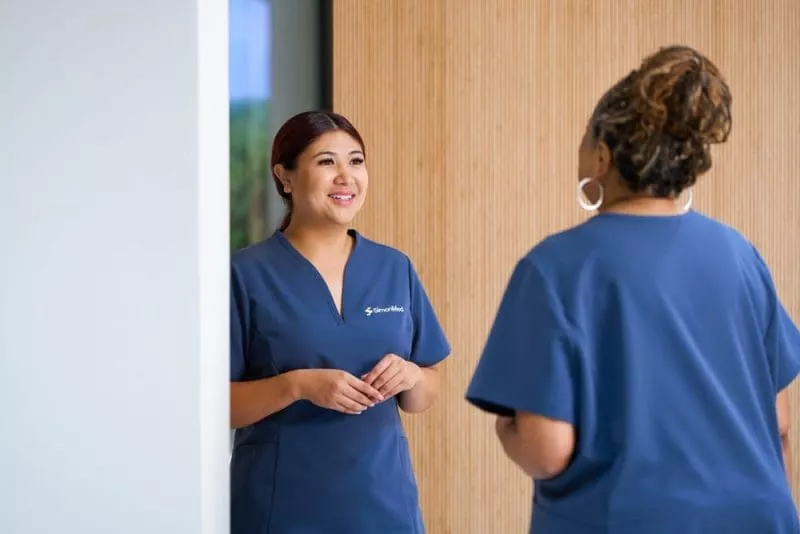
Before your exam, our care team will explain each step, answer questions, and help ensure you feel fully comfortable and prepared.
Who choose SimonMed for Nuclear Medicine
SimonMed brings advanced technology and physician-led expertise to Nuclear Medicine imaging—combining the following to deliver clearer insight into how your organs are working:
Joan G.
Tomball
Waiting room is comfortable and not too cold. Didn’t wait too long. Testing was very quick. Technician was quick and very pleasant.
Barbara B.
Parker
Everyone was friendly and efficient. I was taken back for the exam on time and it was done very quickly. Thank You!
Olivia M.
Kingwood
Great experience with my CT scan at SimonMed kingwood. The technician was kind, patient, and made me feel at ease. The procedure was smooth and much faster than expected. At the front desk they were very nice and professional. Thank you for the excellent care.
Tony A.
Kingwood
The tech (Frank) was great. I have claustrophobia and he worked with me so that I was able to complete the MRI procedure.
Paul M.
Southwest
Overall a great experience. I was able to get an appointment very quickly, the Center was easy to find and park, and the office is modern, professional, and pleasant. The front desk staff were friendly and clear communicators. The technicians also were friendly and very professional. Everyone there knows their stuff. My experience was quite good and very efficient. I wish our entire health care system worked as well.
Roberta F.
McClintock
I am very claustrophobic and my appointment was for an MRI (in a closed MRI machine). The tech, Ivan, had such a calm manner and was so understanding and assured me how easy this would be. I surprisingly was able to feel much less stressed and not at all claustrophobic during the procedure. I would definitely do this again at this facility if an MRI should be required in the future.
Joan G.
Tomball
Waiting room is comfortable and not too cold. Didn’t wait too long. Testing was very quick. Technician was quick and very pleasant.
Barbara B.
Parker
Everyone was friendly and efficient. I was taken back for the exam on time and it was done very quickly. Thank You!
Olivia M.
Kingwood
Great experience with my CT scan at SimonMed kingwood. The technician was kind, patient, and made me feel at ease. The procedure was smooth and much faster than expected. At the front desk they were very nice and professional. Thank you for the excellent care.
Tony A.
Kingwood
The tech (Frank) was great. I have claustrophobia and he worked with me so that I was able to complete the MRI procedure.
Paul M.
Southwest
Overall a great experience. I was able to get an appointment very quickly, the Center was easy to find and park, and the office is modern, professional, and pleasant. The front desk staff were friendly and clear communicators. The technicians also were friendly and very professional. Everyone there knows their stuff. My experience was quite good and very efficient. I wish our entire health care system worked as well.
Roberta F.
McClintock
I am very claustrophobic and my appointment was for an MRI (in a closed MRI machine). The tech, Ivan, had such a calm manner and was so understanding and assured me how easy this would be. I surprisingly was able to feel much less stressed and not at all claustrophobic during the procedure. I would definitely do this again at this facility if an MRI should be required in the future.
Joan G.
Tomball
Waiting room is comfortable and not too cold. Didn’t wait too long. Testing was very quick. Technician was quick and very pleasant.
Barbara B.
Parker
Everyone was friendly and efficient. I was taken back for the exam on time and it was done very quickly. Thank You!
Olivia M.
Kingwood
Great experience with my CT scan at SimonMed kingwood. The technician was kind, patient, and made me feel at ease. The procedure was smooth and much faster than expected. At the front desk they were very nice and professional. Thank you for the excellent care.
Tony A.
Kingwood
The tech (Frank) was great. I have claustrophobia and he worked with me so that I was able to complete the MRI procedure.
Paul M.
Southwest
Overall a great experience. I was able to get an appointment very quickly, the Center was easy to find and park, and the office is modern, professional, and pleasant. The front desk staff were friendly and clear communicators. The technicians also were friendly and very professional. Everyone there knows their stuff. My experience was quite good and very efficient. I wish our entire health care system worked as well.
Roberta F.
McClintock
I am very claustrophobic and my appointment was for an MRI (in a closed MRI machine). The tech, Ivan, had such a calm manner and was so understanding and assured me how easy this would be. I surprisingly was able to feel much less stressed and not at all claustrophobic during the procedure. I would definitely do this again at this facility if an MRI should be required in the future.
Joan G.
Tomball
Waiting room is comfortable and not too cold. Didn’t wait too long. Testing was very quick. Technician was quick and very pleasant.
Barbara B.
Parker
Everyone was friendly and efficient. I was taken back for the exam on time and it was done very quickly. Thank You!
Olivia M.
Kingwood
Great experience with my CT scan at SimonMed kingwood. The technician was kind, patient, and made me feel at ease. The procedure was smooth and much faster than expected. At the front desk they were very nice and professional. Thank you for the excellent care.
Tony A.
Kingwood
The tech (Frank) was great. I have claustrophobia and he worked with me so that I was able to complete the MRI procedure.
Paul M.
Southwest
Overall a great experience. I was able to get an appointment very quickly, the Center was easy to find and park, and the office is modern, professional, and pleasant. The front desk staff were friendly and clear communicators. The technicians also were friendly and very professional. Everyone there knows their stuff. My experience was quite good and very efficient. I wish our entire health care system worked as well.
Roberta F.
McClintock
I am very claustrophobic and my appointment was for an MRI (in a closed MRI machine). The tech, Ivan, had such a calm manner and was so understanding and assured me how easy this would be. I surprisingly was able to feel much less stressed and not at all claustrophobic during the procedure. I would definitely do this again at this facility if an MRI should be required in the future.
Joan G.
Tomball
Waiting room is comfortable and not too cold. Didn’t wait too long. Testing was very quick. Technician was quick and very pleasant.
Barbara B.
Parker
Everyone was friendly and efficient. I was taken back for the exam on time and it was done very quickly. Thank You!
Olivia M.
Kingwood
Great experience with my CT scan at SimonMed kingwood. The technician was kind, patient, and made me feel at ease. The procedure was smooth and much faster than expected. At the front desk they were very nice and professional. Thank you for the excellent care.
Tony A.
Kingwood
The tech (Frank) was great. I have claustrophobia and he worked with me so that I was able to complete the MRI procedure.
Paul M.
Southwest
Overall a great experience. I was able to get an appointment very quickly, the Center was easy to find and park, and the office is modern, professional, and pleasant. The front desk staff were friendly and clear communicators. The technicians also were friendly and very professional. Everyone there knows their stuff. My experience was quite good and very efficient. I wish our entire health care system worked as well.
Roberta F.
McClintock
I am very claustrophobic and my appointment was for an MRI (in a closed MRI machine). The tech, Ivan, had such a calm manner and was so understanding and assured me how easy this would be. I surprisingly was able to feel much less stressed and not at all claustrophobic during the procedure. I would definitely do this again at this facility if an MRI should be required in the future.
Have questions? Get answers
Nuclear Medicine is a type of imaging that uses a tiny amount of radiotracer to show how organs and tissues are functioning. Instead of only showing structure, it helps your doctor see activity at the cellular level.
Your doctor may recommend this scan to evaluate how well certain organs are working, check for inflammation or infection, assess bone health, or look for early functional changes that may not appear on other imaging tests.
Yes. The tracer dose is very small, carefully measured, and used safely every day in hospitals and imaging centers across the country. It naturally leaves your body over the hours following your exam.
You’ll receive the radiotracer either through a small IV or a swallowable dose. After a short waiting period, you’ll lie comfortably on a scan table while the camera captures images. The exam is painless, and our technologists will guide you through each step.
In most cases, yes. Most patients return to their day immediately after the scan. We usually recommend drinking plenty of water afterward to help flush the tracer from your system.
A board-certified radiologist will review your images and send a detailed report to your doctor. Your provider will discuss the results with you and go over next steps if needed.
Not always. Nuclear Medicine provides functional information that can complement other imaging. Your doctor may use it alone or alongside other scans to get a fuller picture.
Timing varies based on the type of study. Some exams are completed in a single visit within a couple of hours, while others require imaging at multiple time points. Your care team will explain what to expect before your appointment.
Yes, but at very low levels. The doses used are typically similar to—or even lower than—what you’d receive in other common diagnostic imaging tests.
Get even more insights into your health
Make the most of your visit to SimonMed with deeper insights into your breast, heart and whole body health.
Ultrasound
Real-time imaging of soft tissues, organs, and blood flow—often used alongside functional nuclear medicine findings.
Coronary CTA (CCTA)
Detailed 3D images of the heart and coronary arteries, helpful for cardiac evaluation when Nuclear Medicine studies indicate functional changes.